Monday, October 12, 2009

A run around Gustavus

I woke up two weeks ago in Gustavus looking for some solitude and adventure. So I decided to run the survey cuts marking the boundary between Gustavus and Glacier Bay National Park. I thought it might take 3 or 4 hours and packed a little food, some iodine pills to refill my water bottle and took off around 10:15am.
Leaving the beach at the west end of Gustavus, near Pt. Gustavus.

You can see from these cuts that the line has been brushed within the last few years. Many of the survey monuments are from 1998, so that may be the first time the line was cleared.

The brushing crew left some things behind. In addition to these loppers, I found a small amount of trash and a few piles of extra orange NPS boundary stakes.

Those blurry white spots are funky little mushrooms pushing up through the duff. Not sure what kind.

There were some wet spots, especially when the line started cutting back east toward Gustavus. (see google map).

One of the two roads I crossed all day. This one goes to the National Park. The other heads to the Falls Creek Hydroelectric project.

A moose hide drug around by wolves or coyotes? Or the sign of a moose shot in the park and drug back across the border? Kinda looks like the former, thankfully.

A sedge darner (type of Dragonfly). I finally got to use my new book "Dragonflies of Alaska" by John Hudson and Robert Armstrong to identify it.

The Salmon River.


The north end of the gravel pits. Supposedly, the pits were dug before the boundary was surveyed and no one knew they were digging in the park.

Found this algae growing on land (seemed very odd to me at the time) north of rink creek road. I photographed it on top of an old General Land Office (them's the homesteading folks) survey monument from 1920.

The most beautiful scenery of the trip. The tri-tone grass made me want to sit down and find my inner Andy Goldsworthy, but the hour was getting a bit late.

Finally made it to the beach. This is near the Bear Track Inn.

Running on home. I made it just after my parents started worrying, but before it was fully dark. In total, 31 miles in 8 hours and 46 minutes. I probably walked 18 miles of it due to wet conditions and the fact that I only brought six 120 calorie gel packs with me for food. The roasting moose that greeted me when I ran into our front yard was a welcome sight.

Friday, September 18, 2009

Wasatch 100


Well that was pretty fun. Geoff rocked it (see his race report and that of his major competitor, Karl Meltzer) and I had fun being his support crew. I didn't get a picture of Katherine, Karl's support crew and a veteran observer of ultrarunning, but she was great company as we waited for the lead runners to come through. Both Geoff and Karl don't rely heavily on support--and probably would prefer races where everyone just uses drop bags and the aid stations, with no personal support crews. At each aid station I would get one of Geoff's drops bags with his nutrition (basically, cliff gels and endurolyte electrolite pills) stuff and put them in a hip belt with fresh water and electrolyte drink. I'd hand this off to Geoff and he'd give me his old belt and keep running, preferably not even stopping at all.

The picture above shows Geoff's drop bag at Brighton, the last aid station where support crew can go. It includes his night running set-up, with two headlamps, one of which is worn around the waist to better illuminate the trail.

At Brighton, I joined Geoff and tried to keep up with him for the last 25 miles of the race. I made it about 12 miles before he dropped me and kept going. He ended up doing lose last 25 miles (and their ~8,000ft of climbing) is a record setting 4:57. I enjoyed running with him while I could, and being left in the dust, tired and alone in the dark on a famously gnarly section of a famously gnarly 100 mile race, was as good an introduction to the sport as I can imagine. Thanks, Geoff!

Friday, July 11, 2008

This Rural Life

From Verlyn Klinkenborg's editorial in the New York Times today,
What the insects are noticing--the bats, too--is beyond me. Our perceptions overlap without ever converging in the night. All the entangled lives on this farm seem to run on seperate tracks, except where they collide as predators and prey or companion and caretakers. Push this thought far enough, and nature seems to fray, to come apart into a disunity that is gathered up only by our human perceptions. And yet that gathering up is just our own kind of solipsism. I don't know that the horses have ever made a general proposition about nature, but then they don't know that I've made one either.

Freezing Salmon myths

Listen to this, from a blog called Beyond Salmon:
The reason I was so surprised was that I've had previously frozen salmon before that was terrible, so I concluded that salmon doesn't freeze well. What I didn't take into account was that it was wild Coho and Sockeye Salmon that tasted awful. They are extremely lean compared to farm-raised Atlantic or King salmon and do turn to mush when frozen. So when you choose your salmon for freezing, go with Atlantic (always farm-raised) or King (farm-raised or wild).
Absurd. Friends don't let friends eat farmed salmon. For one, it is terrible for the environmentas currently practiced (check out Raincoast Research Society's great work on this subject). For two, all the farmed salmon I've ever consumed has tasted like soggy cardboard--even the fresh farmed king I had in Patagonian Chile.

Also, for the record, we have been freezing king, sockeye, and coho salmon forever with a very high quality result. Our guests rarely, if ever, realize it has been frozen and when we tell them so they begin to question the idea that freezing it so bad for fish. As is mentioned on the blog I bash above (which is pretty well done over all), this is a myth; what is important is how and when the fish is frozen, not whether it was frozen. My dad has always said that freezing should be done very quickly in a good quality freezer and that whole fish survive better than fillets because their is less flesh exposed to the air. From the discussion on the Beyond Salmon blog I learned why quicker is better:
I agree with Tse-Wei aho said that ice crystals can be made smaller if you freeze it very very quickly- metallurgical fact- yes I am a materials doctoral student! So it would make sense that a fish flash frozen at sea would last longer, preserve taste and texture than if you were to do the same thing at home. Also I agree with Helen that you should never defrost meat or fish or any food for that matter very quickly- i.e. do not microwave, or on your counter top.

Wednesday, April 25, 2007

Staying put.

I will wait here in the fields
to see how well the rain
brings on the grass.
In the labor of the fields
longer than a man's life
I am at home. Don't come with me.
You stay home too.

--Wendell Berry

Adams Inlet snakes away from Glacier Bay toward Lynn Canal


through beatiful mountains on all sides. I spent seven days kayaking there last week with Sean Neilson. My journal/gillnet for mystery yields these fish for the bar-b-que:

"This morning we watched a pack of 8 wolves (3 black, 2 grey, one brown and one black/grey/black like an oreo or a scaup). They were walking the beach playfully, visiting the intertidal, tug-of-waring with a piece of something we couldn't make out and rolling in one spot before taking off into the woods a short walk from us. That was pretty wonderful and it seems they weren't aware of our presence until the very end. Interestingly, when the pack passed a group of Canada geese and sea ducks foraging in the intertidal, none of the birds seemed concerned, whereas they fly from our presence at much farther distances. I checked their path for fresh wolf scat, which I've never seen. It looked like a smooth black paste with white hairs throughout (snowshoe hares?) and smelled 'horrid'."

"Today we entered Adams Inlet. From our first site of the mouth of the inlet strange noises confused us. It sounded a bit like a waterfall coming from the middle of the bay but turned out to be a group of ~150 sea lions feeding. The group approached us en masse to within 20 feet and began to scream and levate halfway out of the water. They seemed more curious than angry and we did what anybody would have done: screamed our best barbarian response and snapped photos."

"We saw lots of goats today. As always, their regal faces and agile mountain climbing captivated my attention. This time though, the captivation almost sunk my boat. A goat/subject of our future awarding winning photography we were approaching decided to head up the cliff above us. He sent down a shower of unpredictable rocks (on purpose?) that nearly put a hole in my boat and head. The sea was boiling with his rocks for several minutes--a site that was quite memorable even without the adrenaline-enhanced flee from danger."

"It sank it where I was today when an eagle feather and a steady supply of moose hair (perfect for bird nest making by the way) floated by my kayak. Signs of death as signs of life."

"Our bird list filled in over the course of the trip, following predictably the ecologist's s-shaped species area curve. First, the abundant ones--old skuas, ravens, mergansers, cormorants, guillemonts--and then ones rarer--a magpie, a red-throated loon, and two black turnstones. On our last day, and only day of inclement weather, we saw a group of hundreds of sandhills cranes flying high. The group was flying in pretty severe disorder while over the bay, but we saw them reach the steadier air currents over Gloomy Knob on the horizon and fall like beautiful dominoes into the steady lines that take them through the long haul. The best part about seeing the cranes was the process: you hear them first . . . they sink into your subconcious . . . you look up at the black in the sky . . . feel wonder . . . understanding . . . and then more wonder."

Thank you to those whose hard work protected this wilderness, and whose voices we still need hearing: John Muir is as responsible as anyone for Glacier Bay National Park and knew well the simple truth: "Fear not to try the mountain-passes. They will kill care, save you from deadly apathy, set you free, and call forth every faculty into vigorous, enthusiastic action. Even the sick should try these so-called dangerous passes, because for every unfortunate they kill, they cure a thousand."

Monday, February 26, 2007

Robinson Island Treasure

This update is fueled by a Parrilla and a liter of Hieneken in western Argentina. A Parilla is a mix of different beef parts like intestines, blood, kidney, and stomach. I think I'd have to say at this point that I'd rather they ground it all up and served me a hamburger with lots of ketsup. Maybe in Buenos Aires things will get better. I just finished a month on a farm within Pumalin Park, Chile and two days rafting on the Futeleufu River, one of the best in the world for rafting. Both deserve some more description. But, my travels start with three months on Robinson Crusoe Island, about which I should at least mention.

I spent October, November and December on my knees identifying plants which were giving me alergies on a crazy island 400 miles off the coast of Chile, and part of that country. The island was discovered (for real, not just in eurocentric terms) in 1574 by Juan Fernandez. At that time, 70% of the plants of the island were evolutionarily unique, aka endemic--the highest rate in the world. Some of these species have since been pushed into extinction, but the percentage has changed mostly due to species introductions--the subject of the study that brought me to the island.

While we quietly did our work in the next valley over a treasure hunt went on, directed by Bernard Kaiser. to be continued. . .

Monday, October 09, 2006

Concepcion, Chile

So far, I have conducted a quick survey of people on the bus from Santiago and amoung the youngsters that I've met through my friends in Concepcion (one has been here for 7 months). Almost to a person, when I bring up Robinson Carusoe Island I get an excited response about how unique the flora is there and how important a place it is. Of course, they are right: it has by some estimates the most unique flora in all of planet Earth, with 70% of species endemic. Hearing this articulated by 21 year old teaching students is pretty cool.

Another cool find: super nasturiums growing as weeds alongside the soccer field.

Update: It's Robinson Crusoe Island, not Robinson Carusoe Island.

Friday, September 29, 2006

Monday, September 25, 2006

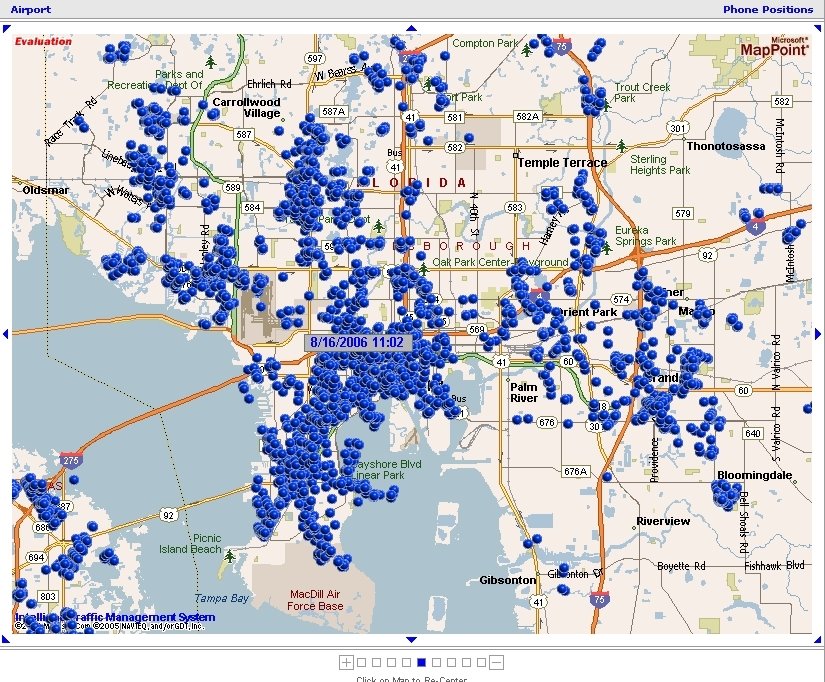
From your phone to your phone traffic data


An NSF funded project that I ran across, using anonymous cell phone location data to show real-time traffic details. It is always reassuring that somebody is thinking creatively out there. Even if is solves problems that control ubran sprawl, there are climate change, not to mention mental health, benefits to reducing traffic congestion.

Photo credit: IntelliOne Technologies Corporation

Sunday, August 27, 2006

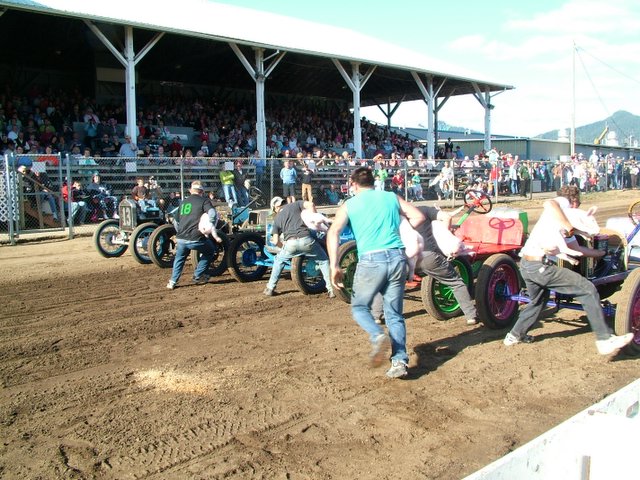
Pig N Fords


Here is how the official website describes this year's 81st annual Pig N Ford races at the Tillamook County Fair:

Saturday World Championships

1. Bobby Wasmer
2. Marty Walker
3. Chris Hurliman
4. John Haertel
5. Ben Salo (DQ)

"Bobby had a great start and was able to jump to the early lead and never look back. Marty stayed close throughout the race trying to find an opening. John had some starting troubles, which gave Chris the opening to get the final trophy position. Ben decided to have a little fun while he was in the back of the pack and skip an exchange for fun. The crowd loved it and was able to finish third without the final exchange, but skipping the last exchange is against the rules."

Indeed it was an exciting event, made especially entertaining, as they describe, when Ben skipped the third exchange after trouble with the hand cranking during the second exchange put him out of reach of winning.

Wait. . . What about the fact that the sport entails grabbing a screaming piglet under the arm and racing around a horsetrack in a working model T Ford? After 81 years of Pig n Fords, Tillamook County has, believe it or not, made this ritual normal, and non-ironic, within its borders. I'd guess 5,000 people came from around Oregon to see this feat.

After the race, at which PETA was completely absent (It is easy to think the race is cruel to the pigs, but it is nothing compared to the feedlots they were born in), the pigs get auctioned off. My local natural meat provider, Lance, bought six and is fattening them up right now. They will be ready for purchase in late November or December.

Tuesday, August 22, 2006

Mini Watsa's response to my Slime Mold inquiry


Slime Mold 1
Originally uploaded by griles.
Hey,

Thanks for those pictures! I really have never seen anything quite like it... the sime mould I worked with was of a different order and species than these are. All slime moulds come under the class Mycetozoa. Listed below are the different orders and families.

Protostelia
Protosteliida
Myxogastria
Liceida
Echinosteliida
Trichiida
Stemonitida
Physarida
Dictyostelia
Dictyosteliida

I worked with Dictyostelium, and largely laboratory strains that never formed huge masses that your slime moulds (if I may call them that) do.

I believe that the kind you were looking at belong to the order Myxogastria. They are true slime moulds or plamodial slime moulds where cell membranes are missing. These 'cells' just clump together to form these huge feeding stages called plasmodia (exactly what u saw!) that are quite fascinating. Dictyostelia are cellular slime moulds and form much smaller feeding stages.

Your kind actuallym move at the rate of a mm per hour but can go as fast as 2 cm per minute. They just engulf all kinds of organic matter in their paths.

So, in answer to your question, no, these don't look like what I worked with. Mine required a microscope to be viewed. These are fascinating...you should see if you can look at a bunch under a microscope...see the individual spores perhaps.. or just starve a glob of it and watch the spores form. WOnder what they'll look like then...

Friday, July 28, 2006

Almost Got Stuck


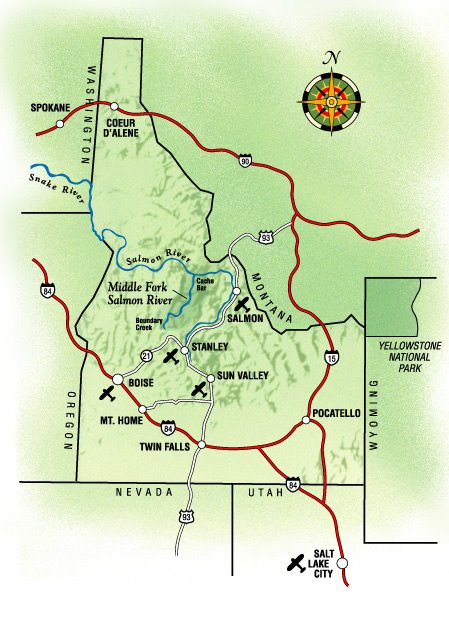
I just returned from 8 days rafting in the Idaho wilderness. Swimming ten times a day in a wild, cool river to get out of the heat, learning to navigate a raft through rapids, and enjoying great company and great views. It all kept me busy and happy.

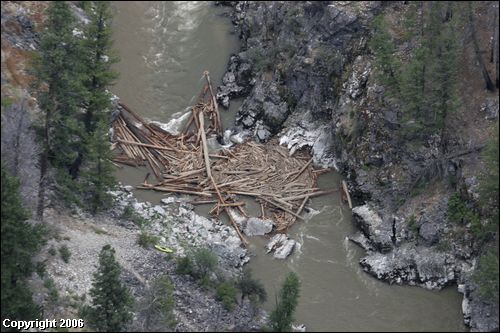
On our last day we noticed the river was full of sediment. It turned out that rafters mere days behind us on the Middle Fork were stuck by a surprise landslide that sent dozens of trees in the river, blocking the way. It was well reported by The Idaho Statemen, a Boise newspaper. Check out their articles for pictures, movies, and details.

Middle Fork Diving


Jumping of the bridge
Originally uploaded by griles.

Sunday, July 16, 2006

Middle Fork of the Salmon River


For the next eight days, I will be on a three-person raft floating down the Middle Fork of the Salmon River in central Idaho with 12 Idahoans. This flows north from Stanley, ID through the Frank Church-River of No Return Wilderness, the second largest wilderness area in the lower 48s, to the main branch of the Salmon. The Salmon flows into the Snake near the western edge of Idaho, and eventually into the Columbia just East of the Gorge.

My hosts with be the Marvels. Johanna is an old friend from Grinnell, Adam is her older brother and lives and acts in London, Jon is her father, a retired architect who runs the Western Watersheds Project, and Stephanie is her mother. They have rafted this river together more than 8 times.

Look forward to sharing some photos and maybe a plant or bird list when I get back.

Friday, July 14, 2006

Molly and Noah's Wedding


Originally uploaded by griles.
Concopia, Wisconsin. June 25th.

Boat tour through the Apostle Islands, wiffle ball on the beach, raising the huppa, meeting Noah's high school friends, and listening to the two best wedding toasts. And, of course, a powerfully genuine and personal Jewish wedding of two of my closest friends.

Saturday, June 17, 2006

Carbonate Mountain Still Life


Carbonate Mountain Still Life
Originally uploaded by griles.
This photo is from Hailey, Idaho on Memorial Day. I stopped there on my drive from Kansas to Oregon, where I now live. Idaho has some big country, especially impressive when the wildflowers are getting their groove on. My host in Hailey was Jon Marvel, executive director of the Western Watersheds Project, which at any given time has several lawsuits against BLM in the works. I now work for BLM as a botanist. We had some good conversations about the mythology of the american west and the reasons for BLM's inept management style. On my drive, I also visited with old friends from Alaska: Gretel Haight and family in Longmont, Colorado and Alison Higdon and family in Hailey--great people who are thankfully bringing more great people into the world.

Friday, May 19, 2006

Lemesiur's Yeast


Lemesiur Cabin
Originally uploaded by griles.
I spent some time on Lemesiur Island with friends Bob, Hank, and LInnea last week. Since then I have been mulling over a few great quotes, which are sitting in me like yeast. If I remember right Mr. Lemesiur was a chef on Vancouver's expedition to Southeast Alaska. Here, it seems, is his recipe for young men trying to find a niche and a right livelihood:

"Conservation as we know it is not an adequate response to an economy that is inherently wasteful and destructive"
- Wendell Berry, "Hell no. Of course not. but . . . " Arctic Refuge: A Circle of Testimony. Edited by Hank Lenfer and Carolyn Servid

"The more I understand hope, the more I realize that all along it deserved to be in [Pandora's] box with the plagues, sorrow, and mischief; that it serves the needs of those in power as surely as belief in a distant heaven; that hope is really nothing more than a secular way of keeping us in line."
- Derrick Jensen, "Beyond Hope" Orion May/June 2006.

Tuesday, May 09, 2006

Falls Creek Hydro Project Underway


Bob Christenson and Greg Streveler
Originally uploaded by griles.
As Greg Streveler (pictured on left) said yesterday, "[Gustavus] wanted a bit of the outside world, and we got it."

The Falls Creek Hydroelectric Project has been approved and construction in in full swing. The picture is of the road to Falls Creek which is now under construction.

To those of you who don't know, this project is being done on Glacier Bay National Park land (and wilderness designated land at that). Bob Christenson (pictured on right) is in charge of environmental compliance for the project.

To get a sense of why this project is happening, read this short article in the Alaska Journal of Commerce. Notice the complete lack of reference to the environmental impacts of this project, and the haughty impatience for a project with very dubious environmental and economic benefits.

Saturday, May 06, 2006

Dan's Best of Iowa Part 3: Prairie Reconstruction


Spring Burn at CERA
Originally uploaded by griles.
Tallgrass prairie once spread throughout central North America, as did bear, elk, bison, and prairie wolf. In Iowa, 99.9% of this ecosystem has been lost to the plow--one of the most drastic and widespread landscape changes in human history. Over 95% of Iowa is now privately owned (the second highest percentage in the nation), the vast majority of which is corn and soybeans destined for consumption by hogs, chickens, and cows in massive confinment feeding operations.

Out of this monumental change has grown an equally unique response. Iowans have come to know, like almost no one else, that it is too late to save many of our "last great places", the call of the Nature Conservancy. Indeed, it is the truly greatest, most unbelievably rich places that disappear first. Such as Iowa.

We can protect Iowa's remaining postage stamp remnant prairies and savannas, but reconstruction is the primary tool for recreating vast swaths of flatland prairie, the kind that you can get lost in, along with a herd of bison. These are the places that will have the power and saliency to truly bring Iowa back to its rightful place as one of America's natural treasures and to finally sink the nail into the coffin of the pessimistic and simplistic idea of ecological sacrifice.

The best example of this kind of restoration is the Neil Smith National Wildlife Refuge just east of Des Moines. At 8,000 acres and only 15 years, it is one of the most ambitious restoration projects ever, though by no means is it finished.

For now, however, many of the smaller reconstructions that dot the rest of Iowa are more beautiful and diverse. They have given many, many contemplative Iowans a chance to commune with their degraded landscape, and to try to revive it with their attention and intention. For me, prairie restoration has been one of the most hopeful and spiritually salubrious activities I have ever participated in. It has given me a chance to see how Iowans tick and to share in their long vision for the future of this most contentious landscape.

For more information, watch the trailer of the great documentary America's Lost Landscape: The Tallgrass Prairie.